
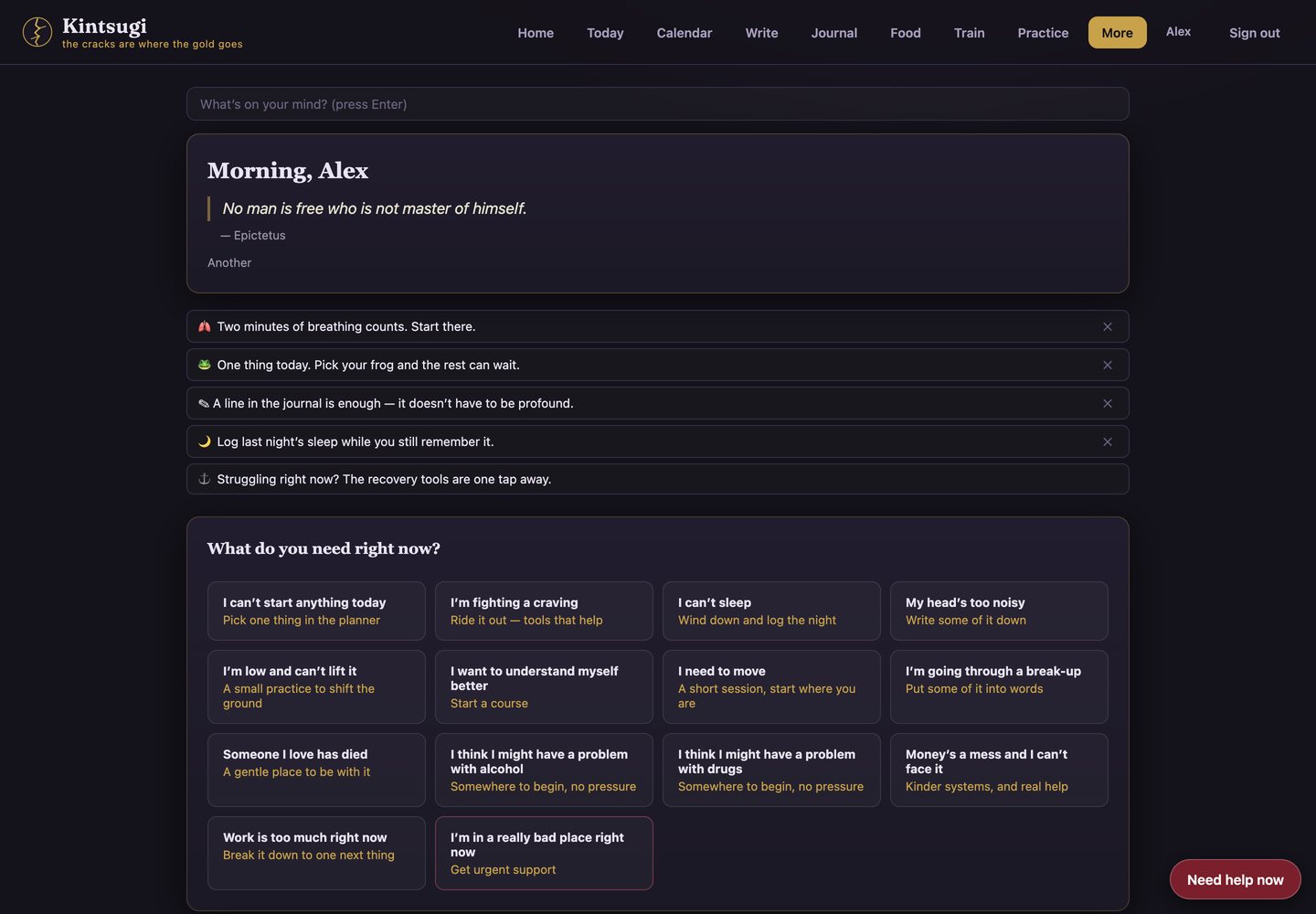
Every refusal in this app came from somewhere. This page sets out the psychology the design leans on, and is written so you can disagree with it — a product that makes claims about your mind owes you its reasoning.
A caveat first. This describes why the software behaves as it does. It is not therapy, not a course, and not a substitute for working with someone. Where the ideas below come from clinical models, they are being borrowed for design decisions, not delivered as treatment.
The abstinence violation effect, and why streaks had to go
In relapse-prevention research, notably Marlatt and Gordon’s work, one of the most damaging things after a lapse is not the lapse itself but what a person concludes from it. Treat one slip as proof the whole effort has failed and the likelihood of it becoming a full return goes up sharply. The technical name is the abstinence violation effect; in ordinary language it is the moment where you think “well, that is that ruined” and the evening gets much worse.
A streak counter is a machine for producing exactly that thought. It takes a long, complicated history and reduces it to a number that goes to zero, and it delivers that verdict at the worst possible moment. Which is why Kintsugi counts time forward, keeps the whole record, and has nothing that resets.
Self-criticism is not motivation
The intuition that being hard on yourself will make you try harder does not survive contact with the evidence. Work on self-compassion, much of it by Kristin Neff and colleagues, consistently finds the opposite: people who respond to their own failures with some kindness are more likely to try again, take responsibility, and stick at difficult change. Harshness mostly produces avoidance, and avoidance looks like not opening the app.
That is why nothing here turns red, no copy implies you have let anyone down, and there are no notifications engineered around guilt.
Action comes before motivation, not after
Behavioural activation, one of the better-evidenced treatments for depression, rests on an inversion most people find counter-intuitive: you do not wait to feel like it and then act, you act and the feeling follows, sometimes days later. Waiting for motivation is a losing strategy precisely when you need it most.
So the app is built around very small specified actions rather than goals, and Movement asks you to start a session rather than to feel ready for one.
One thing, decided in advance
Peter Gollwitzer’s work on implementation intentions found something reliable: a vague intention (“I should sort the paperwork”) converts to action far less often than a specific if-then plan naming when and where. Deciding in the moment costs energy that, on a bad day, you do not have.
The planner asks you to nominate one task, chosen before the day starts, and holds you to it. A rule you can walk around is not a rule, so it is enforced rather than suggested — you can always swap the one you picked, but you cannot quietly end up with five.
Working memory belongs outside your head
Russell Barkley’s account of ADHD frames it less as an attention deficit than as a difficulty with executive function — holding intentions, resisting the more interesting thing, acting on a plan made earlier. The practical consequence is that anything relying on remembering at the right moment will fail, and the fix is to put the remembering outside yourself, in the environment.
Hence the inbox: capture everything so none of it is being held, then decide separately. Two jobs, never at once.
Urges peak and pass
Urge surfing, from the same relapse-prevention tradition, rests on an observation people find genuinely surprising the first time: a craving is not a rising line that goes on for ever, it is a wave. It builds, peaks, and comes down on its own, usually inside half an hour, whether or not you act on it. You do not have to defeat it. You have to outlast it.
Several of the written practices are built for that half hour, and the timed sessions in Focus work on the same principle applied to avoidance rather than craving.
Thoughts are events, not instructions
Acceptance and commitment therapy, developed by Steven Hayes and others, uses the term cognitive defusion for stepping back far enough to notice a thought as a thought — “I am having the thought that I have ruined this” rather than “I have ruined this”. The aim is not to argue the thought down or replace it with a cheerful one, which rarely works, but to loosen its grip enough to act anyway.
This is why the Reflection prompts ask what happened and what you noticed, and never ask you to reframe it into something positive.
Autonomy, competence, connection
Self-determination theory, from Edward Deci and Richard Ryan, holds that motivation which lasts depends on three things: some sense of choosing it yourself, some sense of getting better at it, and some connection to other people. Rewards and pressure applied from outside can reliably shift behaviour in the short term and reliably corrode the internal reasons for doing it.
Applied here: no points, no badges, no leaderboards, no daily nagging. The app tries to be useful when opened and to leave you alone when not.
Habits live in contexts, not in willpower
Habit research consistently finds behaviour is cued by context — time, place, mood, the people around you — far more than by resolve. It is also why the times habits are easiest to change are precisely the disruptions: a move, a break-up, a job ending. The scaffolding that held the old behaviour is briefly gone.
Which is a hopeful thing to know when your life has just come apart, and part of why this app is aimed at people in that moment.
Isolation is a risk factor, not a side issue
Loneliness predicts worse outcomes across nearly everything this app touches — mood, drinking, relapse, physical health. If a substance was also your social life, stopping removes both at once, which is a large part of why early recovery is so precarious.
No app fixes that, and one that claimed to would be lying. What this one does is point hard at the things that do, which is why hobbies, volunteering and meetings sit on the support page as seriously as the helplines.
What this does not mean
Naming research does not make a product clinically effective, and Kintsugi has not been trialled. These are principles used to decide what to build and, more often, what to refuse to build. The honest claim is that the design is informed by this literature — not that using the app produces the outcomes the literature describes.